Ginger and Turmeric: why they work differently in the body and how nano-encapsulation can help
Ginger and turmeric are two of the most recognisable botanicals in global food and wellness traditions. Used for centuries across Asia, the Middle East, and beyond, both roots are valued for their warming qualities, distinctive flavours, and broad supportive roles in human health.
Despite their frequent pairing – in cooking, teas, and supplements – ginger and turmeric behave very differently inside the body. Their active compounds differ in structure, solubility, metabolism, and absorption. As a result, they face different physiological challenges, and benefit in different ways from modern formulation approaches such as nano-encapsulation.
Understanding these differences helps clarify why some botanicals work well in simple preparations, while others require more sophisticated delivery systems to realise their full potential.
Ginger and Turmeric: shared benefits, different Chemistry
At a high level, ginger and turmeric are often associated with similar outcomes:
- Antioxidant activity
- Support for the body’s inflammatory response
- Digestive comfort
- General cellular resilience
These overlaps are real, but they arise from different molecular pathways.
Turmeric’s key active compounds are curcuminoids, particularly curcumin. Ginger’s primary actives are gingerols and shogaols. Though both groups of compounds are polyphenolic in nature, their physical properties differ significantly – and those differences determine how the body handles them.
Turmeric: high potential, low natural absorption
Curcumin is one of the most extensively researched plant-derived compounds in modern science. In laboratory settings, it demonstrates broad biological activity, interacting with oxidative stress mechanisms, inflammatory signalling pathways, and cellular regulatory systems.
Research reviews suggest that curcumin from turmeric may support metabolic balance through its interaction with the gut microbiota and related signalling pathways. Evidence indicates that curcumin metabolites formed during digestion, including those produced through microbial fermentation, play an important role in influencing glycaemic regulation and inflammatory balance. These effects appear to extend beyond the gut, with observed associations involving the pancreas, liver, adipose tissue, skeletal muscle, and the gut–brain axis. Reviewed findings describe modulation of insulin signalling, glucose transport mechanisms, intestinal barrier function, and inflammatory mediators as part of this broader systemic response. Taken together, the literature indicates that curcumin’s physiological activity is not solely dependent on the parent compound, but also on its metabolites and their interaction with gut–organ communication pathways.
Curcumin, widely recognised for its biological potential, has inherently low bioavailability in the human body. This is largely due to poor water solubility, limited absorption across the intestinal wall, and rapid metabolic conversion, which together mean that a significant proportion of ingested curcumin is eliminated before it can enter circulation. Translating this potential into practical benefit has proven challenging.
The Key Challenges with Turmeric (Curcumin)
1. Curcumin has very low water solubility
Curcumin is strongly hydrophobic. In the watery environment of the digestive tract, it does not dissolve easily, limiting its contact with the intestinal lining.
2. Rapid metabolism can reduce curcumin activity
Any curcumin that is absorbed is quickly transformed by enzymes in the intestinal wall and liver into metabolites with reduced activity.
3. Curcumin has limited cellular access
Curcumin struggles to cross cell membranes efficiently, restricting its ability to reach intracellular targets.
As a result, consuming turmeric powder or standard curcumin extracts often leads to very low circulating levels of intact curcumin reducing the intended effects and benefits.
This does not mean turmeric is ineffective, rather, it is delivery-limited.
Ginger: naturally more accessible, but not without limits
Ginger’s primary active compounds – gingerols and shogaols – share some functional similarities with curcumin, but behave very differently in the body.
Why Ginger Is Easier to Absorb
- Gingerols are more soluble in both water and lipids
- They disperse more readily in digestive fluids
- They are metabolised more gradually
- Ginger naturally stimulates digestion, indirectly enhancing its own absorption
This is why ginger often works well in simple formats such as teas, powders, or basic extracts.
Ginger’s Limitations
Despite its advantages, ginger is not without challenges:
- Some ginger compounds are chemically unstable, converting into other forms with heat, drying, or prolonged storage
- Absorption and effect can vary depending on preparation (fresh vs dried vs extract)
- Rapid uptake may lead to shorter-lived effects compared to compounds designed for sustained delivery
In other words, ginger is naturally accessible, but not optimised for longevity or targeted delivery.
Ginger and Turmeric: different problems, shared solution
This contrast highlights an important principle:
Not all botanicals need the same level of formulation support – but most benefit from thoughtful delivery.
- Turmeric’s challenge is getting enough active compound into circulation
- Ginger’s challenge is maintaining stability and consistency
While ginger and turmeric face different physiological challenges, advances in delivery science provide a common framework for improving stability, consistency, and effective absorption.
This is where modern delivery systems enter the discussion, such as nano encapsulation.
What Is Nano-Encapsulation – and Why It’s Used
Nano-encapsulation refers to enclosing bioactive compounds within extremely small carrier structures, typically made from food-grade lipids or biocompatible materials. Like surrounding the bioactive compound in a bubble that helps to deliver the compound to where it needs to be in a better form.
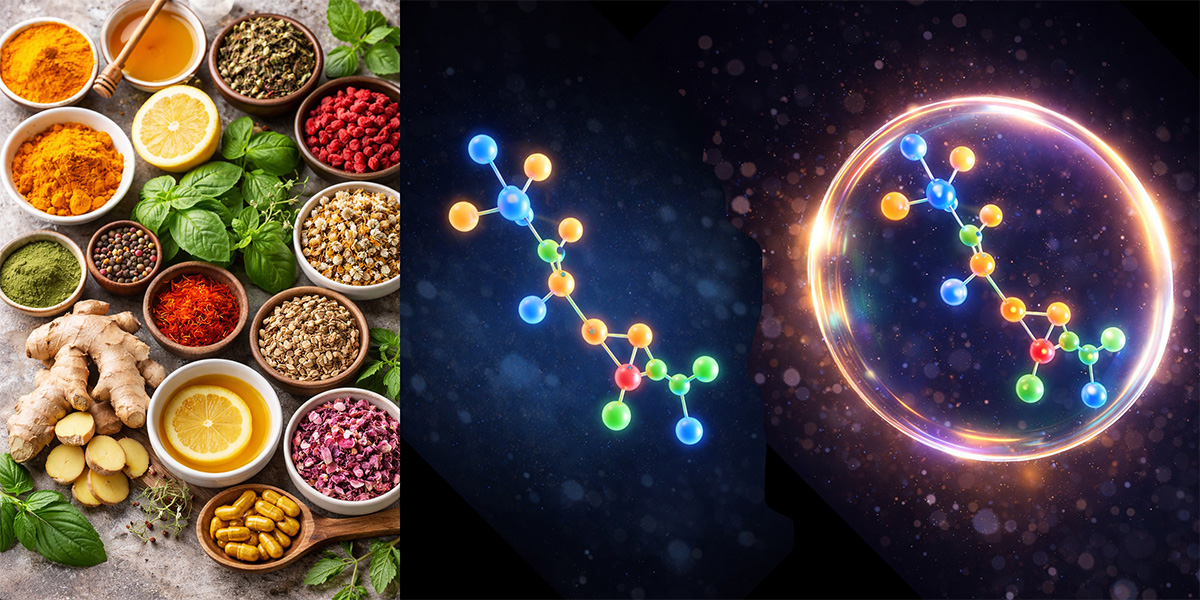
Rather than changing the compound itself, nano-encapsulation changes how it is presented to the body.
These carriers are designed to:
- Protect sensitive compounds during digestion
- Improve dispersion in digestive fluids
- Facilitate interaction with natural absorption pathways
Nano-scale delivery systems are widely used in pharmaceutical science and functional nutrition, particularly where natural absorption is limited or inconsistent.
How Nano-Encapsulation Helps Turmeric
For turmeric, nano-encapsulation directly addresses its primary weaknesses.
Potential benefits include:
- Improved dispersion of curcumin in aqueous environments
- Protection from early metabolic breakdown
- More efficient passage across intestinal barriers
- Greater likelihood of reaching cellular targets
Importantly, this approach focuses on working with the body’s existing lipid absorption mechanisms, rather than forcing absorption through metabolic interference.
For curcumin, delivery is not a refinement – it is often a prerequisite for meaningful exposure.
How Nano-Encapsulation Can Help Ginger (Differently)
Ginger does not require nano-encapsulation to be absorbed, but it may benefit from it in other ways.
Potential advantages include:
- Improved stability of gingerols and shogaols
- More consistent dosing between preparations
- Slower, more sustained release
- Reduced degradation during processing and storage
In this context, nano-encapsulation is less about unlocking ginger’s activity and more about refining and stabilising it.
A Side-by-Side Perspective
Aspect | Turmeric (Curcumin) | Ginger |
Natural absorption | Very low | Moderate to good |
Primary challenge | Bioavailability | Stability & consistency |
Needs delivery support | High | Optional but beneficial |
Role of nano-encapsulation | Essential for effectiveness | Enhancing refinement |
Typical effect profile | Broad, systemic | Faster, digestive-linked |
This comparison explains why turmeric is often the focus of advanced formulation research, while ginger is frequently effective in simpler forms.
Complementary, Not Competing
Seen together, ginger and turmeric illustrate how traditional botanicals and modern science intersect.
- Ginger shows how naturally bioavailable compounds behave in the body
- Turmeric shows why some compounds require technological assistance
- Nano-encapsulation bridges the gap between ancient plant knowledge and contemporary physiology
Rather than replacing traditional use, modern delivery systems refine it – adapting time-honoured botanicals to the realities of the human digestive system.
Conclusion
Ginger and turmeric share a long history of use and a reputation for supporting balance and resilience in the body. Yet their active compounds face very different physiological challenges.
Ginger is naturally accessible but chemically sensitive. Turmeric is biologically powerful but poorly absorbed. Nano-encapsulation does not elevate one above the other – it addresses specific limitations inherent to each.
As understanding of nutrient delivery evolves, these botanicals demonstrate a broader truth in modern wellness science:
Effectiveness depends not only on what a compound does, but on how the body receives it.